There is a familiar moment in a company booking several shows with different footprints over the next year: the plan looks settled until one ordinary question exposes three decisions nobody made. That is not a failure of effort. It is a sign that the plan was built around objects rather than use. The framework below puts people, sequence, and constraints back in the center so the final choice feels intentional instead of merely expensive.
This guide is for exhibitors choosing an exhibit model for one show or a developing program. By the end, you will have a use-case comparison that includes hidden operating effort. Use the ideas as a planning framework rather than a universal ‘best’ list: confirm current specifications and policies with the provider you choose, then adapt the details to your own space, team, timeline, and budget.
Start with the fork in the road
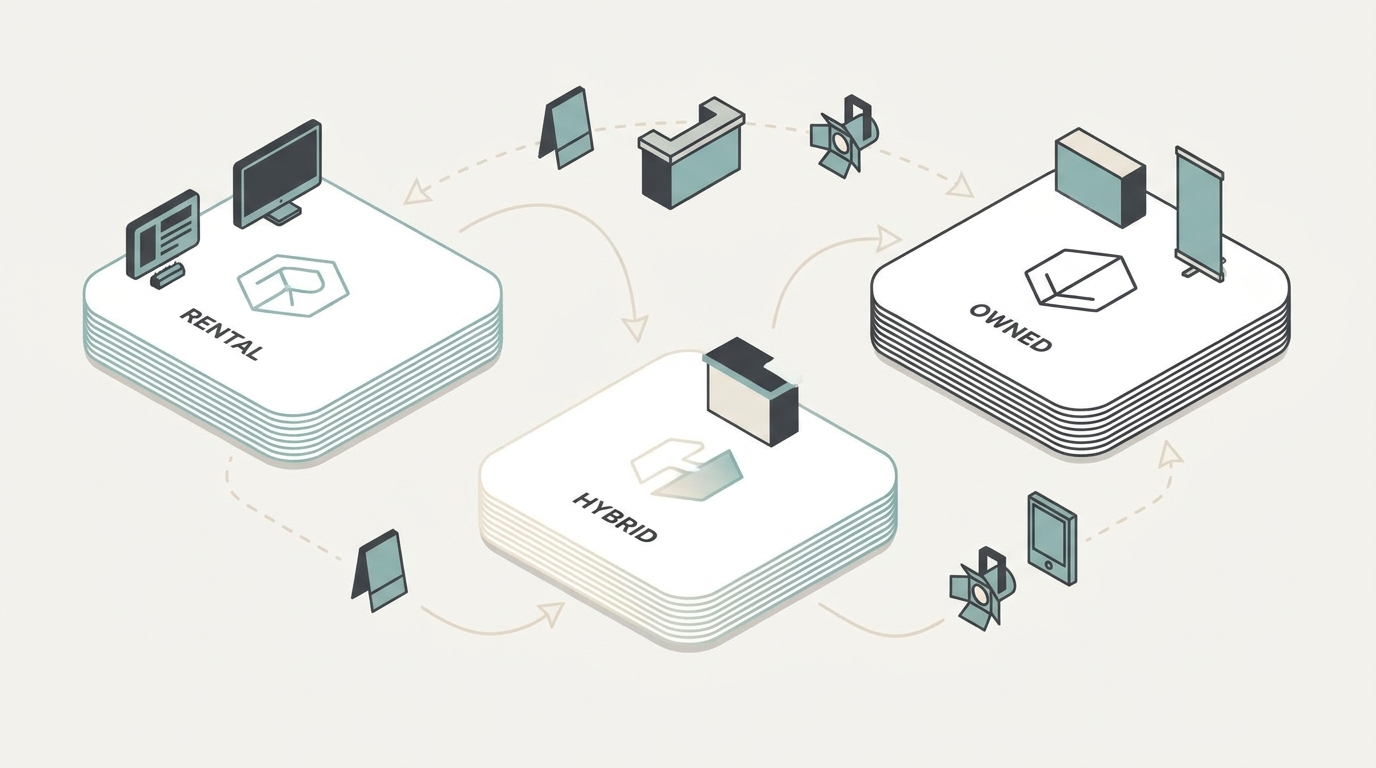
Choose rental for flexibility and lower ownership burden, custom for repeated distinctive needs, and hybrid when branded reusable elements can sit inside changing rental structures. Compare annual use, not one invoice.
That short answer is useful because it creates a boundary. The common mistake is treating rental as generic and custom as automatically premium. A boundary gives every later option a job: it either supports an exhibit model the team can afford to operate well or it does not. This does not remove taste or judgment. It simply prevents a loud detail from outranking the experience you are trying to create.
Questions that reveal the right branch
- Primary user: Name the person whose experience matters most.
- Success signal: Describe the visible result in plain language.
- Hard limit: Record the budget, space, time, or capacity boundary.
- Owner: Give one person authority for the next decision.
Read the brief aloud as if you were handing it to someone who missed every earlier conversation. If that person could make a sensible next move, the brief is doing its job. If not, the missing piece is usually an owner, a limit, or a definition of success. For a company booking several shows with different footprints over the next year, those three details matter more than adding another inspiration link.
The decision tree
1. Map the next twelve months
Map the next twelve months. The practical test is whether a newcomer can understand what happens next without a private explanation. If the answer depends on tribal knowledge, add one label, owner, or checkpoint. This keeps the recommendation aligned with planning exhibit programs that are clear to visitors and manageable for the team delivering them.
2. Identify truly distinctive needs
Identify truly distinctive needs. Cost matters, but total effort is the better filter. Include setup time, coordination, storage, revisions, and the attention required on a busy day before calling an option economical. If the choice cannot be explained in one sentence, it probably needs another pass.
3. List what must travel
List what must travel. Keep the first version deliberately plain. Once the basic flow works, style and optional features can be added without hiding a weak decision underneath decoration. A five-minute review here can prevent an hour of cleanup later.
4. Count storage and handling
Count storage and handling. Look for the exception that is likely to occur, not every exception imaginable. A simple fallback for the most common snag protects the plan without turning it into a manual nobody reads. The goal is a repeatable result, not a perfect-looking planning document.
5. Compare show-service dependencies
Compare show-service dependencies. Write down what ‘done’ means. That small act prevents two people from carrying different pictures of the result and discovering the mismatch when changes are expensive. For exhibitors choosing an exhibit model for one show or a developing program, that usually means choosing clarity over novelty.
6. Model refresh and repair
Model refresh and repair. Start by naming the decision this element should support. A useful choice removes friction for the people doing the work; an impressive-looking choice that creates extra handoffs is usually a poor bargain. This keeps the recommendation aligned with planning exhibit programs that are clear to visitors and manageable for the team delivering them.
7. Choose a reversible first step
Choose a reversible first step. Treat this as a working assumption, not a permanent rule. Put it into one real scenario, note where people hesitate, and adjust the smallest part that caused the hesitation. If the choice cannot be explained in one sentence, it probably needs another pass.
Run the three-show test
Place the same exhibit model into three plausible events: the flagship show, a smaller regional event, and a specialized conference with an unusual footprint. Ask what ships, what changes, what the local vendor supplies, and what the team stores between dates. The model that remains understandable across all three deserves the next round of pricing.
A side-by-side reality check
| Option | Best when | Watch for |
|---|---|---|
| Rental | Footprints change or the program is still learning | Finish and availability depend on partner inventory |
| Custom | A stable program repeatedly needs distinctive architecture | Storage, freight, repair, and refresh continue |
| Hybrid | Branded assets can pair with flexible structure | Compatibility and asset ownership need documentation |
The table is a conversation tool, not a verdict machine. Weight the column that protects an exhibit model the team can afford to operate well most strongly. When two options remain close, choose the one that will be easier to explain, own, and revise. People tend to remember a smooth experience; they rarely remember how many features were available behind it.
Red flags worth noticing
- Only fabrication is compared. Include design, drayage, storage, labor, repair, and disposal.
- One show represents the whole program. Model the range of footprints and cities.
- Reuse is assumed. Name who stores, inspects, updates, and ships each asset.
Notice that each correction is small. That is intentional. Plans become brittle when every concern produces another platform, prop, meeting, or rule. Fix the point of confusion first, observe the result, and only then decide whether more structure is justified.
Three useful conversations
- Ask the owner: “What decision do you need from me, and by when?”
- Ask the user: “Where would this feel confusing or slow in a real a company booking several shows with different footprints over the next year?”
- Ask the vendor: “What is included, what is optional, and what changes after we approve?”
These questions are intentionally ordinary. Clear questions produce comparable answers, while broad requests for recommendations often produce polished sales language. Record the answers in the same place so the final decision can be traced without reconstructing a long email chain.
Frequently asked questions
How early should I decide on rental versus custom trade show booths?
Decide the requirements as soon as the real users, constraints, and owner are known. You do not need every detail at that point. Lock the outcome and the hard limits first, then preserve room to revise optional choices as current prices and availability become clear.
Is the premium option automatically the better choice?
No. A premium price can buy finish, support, capacity, or convenience, but only some of those may matter for an exhibit model the team can afford to operate well. Compare the complete experience and ongoing effort, not the label or the longest feature list.
What should I verify before committing?
Confirm the written scope, total price, dates, dimensions or capacity, revision rules, cancellation terms, support route, and every assumption that could change the result. Save the final version in a place the people responsible for delivery can access.
The confident handoff
A strong plan for rental versus custom trade show booths is not the one with the longest feature list. It is the one that makes the next decision obvious and keeps an exhibit model the team can afford to operate well visible when tradeoffs appear. Write the brief, walk through one realistic scenario, compare only the options that satisfy the brief, and name the owner of the next step. That is enough structure to move with confidence without pretending every detail can be predicted.
Before publishing or purchasing, verify current prices, dimensions, availability, contract terms, and product details with the relevant provider. Exhibit Booth Brief offers independent educational planning content and does not present sponsored placements as editorial recommendations.